Yes, you can take a power bank on a plane. Every major airline allows it, on two conditions: it travels in your hand luggage, and its capacity stays under a limit set by international aviation safety rules. Bring one that runs over that limit, or pack it in the wrong bag, and you lose it at security. In the worst case, staff pull your suitcase off the flight while you wait at the gate. So before you fly, it pays to know three things: what the rules say, how to read the numbers printed on your battery, and which models clear security without a fuss.
Checked luggage vs. carry-on: where the power bank goes
Start with the rule that trips up the most travelers: a power bank belongs in your carry-on baggage, never in checked luggage. That holds under IATA regulations, under the TSA guidelines in the United States, and on every commercial airline and route you might book. It isn’t paperwork for its own sake. It comes down to fire.
Almost every modern power bank runs on lithium-ion cells, and lithium-ion cells can, in rare cases, enter thermal runaway: a self-feeding reaction that throws off heat and sometimes flame. A damaged or defective cell reaches that state most easily under pressure changes and rough handling, the exact conditions a bag meets in the hold. Up in the cabin, a flight attendant spots the problem and drops the device into a fire-containment bag within seconds, and planes carry those bags for this one reason. Down in the cargo hold, nobody sees the smoke and nobody reaches the battery, so aviation authorities draw a hard line: spare lithium batteries stay out of checked bags.
The fallout is worth picturing. Leave a power bank in a suitcase you have already checked, and one of two things follows. Either the scanner catches it and the airline strips it from your bag, which you may or may not get back at the other end, or the airport pulls the whole suitcase from the aircraft after you have boarded, and your luggage stays behind while you fly on. Keep power banks in your cabin baggage, near the top where you can reach them, since staff at the airport security checkpoint may ask you to take them out.
What is the maximum power bank capacity allowed on a plane?
Most of the confusion sits here, because airlines count capacity in watt-hours (Wh) while the big number on the case is almost always milliamp-hours (mAh). The limits themselves stay simple. IATA rules sort lithium-ion power banks into three bands:
- Up to 100 Wh: fine in carry-on, no approval needed. This band covers nearly every consumer power bank sold, including everything Canyon builds for travel.
- 100 to 160 Wh: allowed in carry-on, but you clear it with the airline first, and you carry no more than two. Large camera rigs and laptop power stations tend to land here.
- Over 160 Wh: banned from the passenger cabin. These industrial batteries ship as dedicated cargo under separate rules.
One detail travelers miss: even at the 100 Wh mark, you may carry two spare batteries on top of the ones already inside your phone and laptop. A couple of power banks in a backpack won’t bother the crew, as long as each sits under the limit.
How to convert mAh to Wh: the formula airlines actually look at
Manufacturers print 10,000 mAh or 20,000 mAh on the case because shoppers recognize the figure. Airlines and security teams work in watt-hours instead, since Wh reflects the energy stored and the risk that energy carries. One line of arithmetic bridges the two:
Wh = (mAh × V) / 1000
V is the cell voltage. For the lithium-ion cells inside almost every power bank, that value sits at 3.7 V, which gives you a quick way to check any model on a shelf:
- A 10,000 mAh bank: (10,000 × 3.7) / 1000 = 37 Wh, far under 100.
- A 20,000 mAh bank: 74 Wh, still comfortable.
- A 25,000 mAh bank: 92.5 Wh, close to the ceiling but under it.
- A 27,000 mAh bank: about 99.9 Wh, right on the edge before you need airline approval.
In practice, any power bank up to roughly 27,000 mAh at standard voltage clears the rule. Canyon’s OnPower travel range sits well below that mark. A few premium models use 3.8 V or 7.4 V cells, which shifts the math, so trust the watt-hour figure printed on the device, because that is the number security reads.
Essential rules for flying with an external battery
Run through this before you leave the house. It costs a minute and spares you an argument at the gate.
- Clear markings. The capacity in mAh, and ideally in Wh, should show plainly on the outside of the case. Once that label wears off, which happens to older banks, security can confiscate the device, because nobody can prove it sits under the limit. A new, well-marked bank sidesteps the whole issue.
- Protect the ports. A loose port in a backpack shorts out the moment it touches a key, a coin, or a set of exposed headphone terminals. Keep the bank in its box, a soft pouch, or a compartment of its own. A short circuit is one of the sparks that sets off thermal runaway.
- Turn it off. Switch the device off, or leave it on standby, as you pass the checkpoint, and unplug any cable.
- Keep batteries apart. Where you can, store power banks away from spare camera cells and vape pens, so terminals don’t meet during a bumpy taxi.
- Keep it reachable. Staff may ask you to lift any power bank out and set it in a tray for the X-ray, so pack it near the top.
How to choose a flight-safe power bank
With the rules settled, the practical question follows: are power bank allowed on airplanes whatever the model, and what should you buy? Any bank under 100 Wh flies, but a well-built one smooths the trip. Look for:
- Capacity printed in both mAh and Wh on the body.
- Certifications you recognize, such as CE, RoHS and FCC, plus clear airline-compliance wording from the maker.
- Built-in guards against overcurrent, overheating, overvoltage and short circuits.
- A size that fits how you travel. 10,000 mAh covers a phone and a couple of top-ups; 20,000 mAh carries a phone and tablet through a long-haul day; 25,000 mAh keeps a laptop alive between terminals.
A few Canyon power banks that travel well
Each model below sits under the 100 Wh ceiling, prints its capacity in plain view, carries the certifications above, and packs the protection circuits that aviation rules ask for.
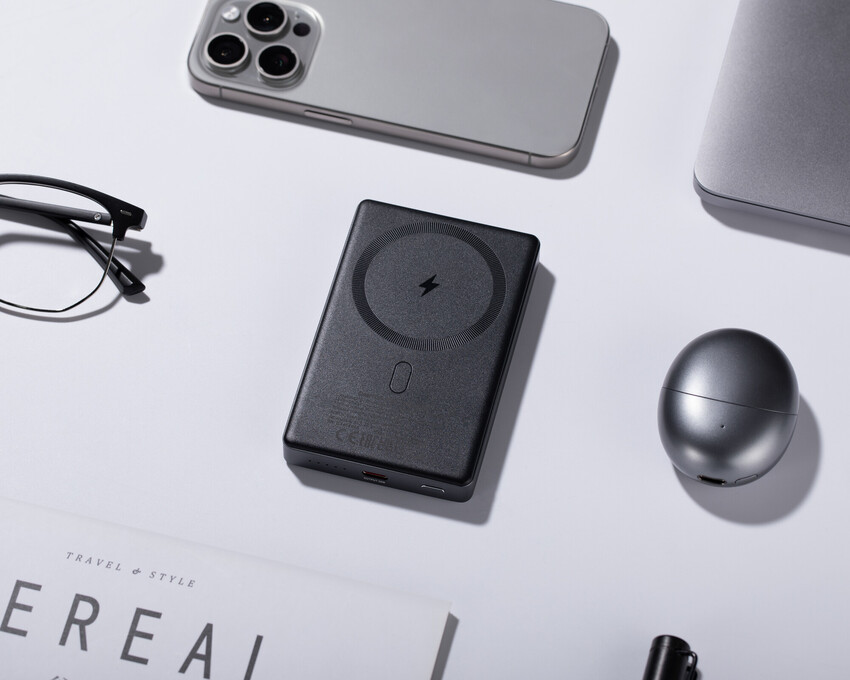
Canyon OnPower 510: 10,000 mAh / 37 Wh
A compact magnetic wireless bank for the lightest travel kit. It clips to the back of a compatible phone and charges it without a cable, and a 20 W USB-C port handles wired charging when you want it. At 37 Wh it stays well under the limit, and Canyon markets it as airline-compliant. Pick it when your worry is a phone and a set of earbuds.
Canyon OnPower 600: 20,000 mAh / 74 Wh
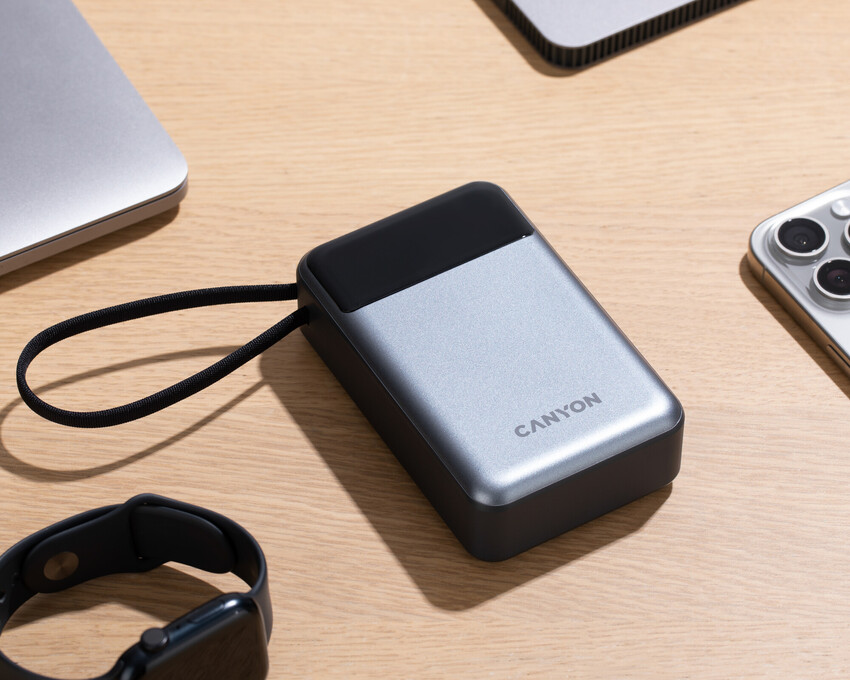
More capacity for anyone carrying a phone and a tablet, or two people sharing one bank across a long day. 74 Wh fits inside the 100 Wh allowance, and the larger cell means several phone charges between sockets, which counts on a travel day where the next outlet is hours off.
Canyon OnPower 240: 25,000 mAh / 92.5 Wh
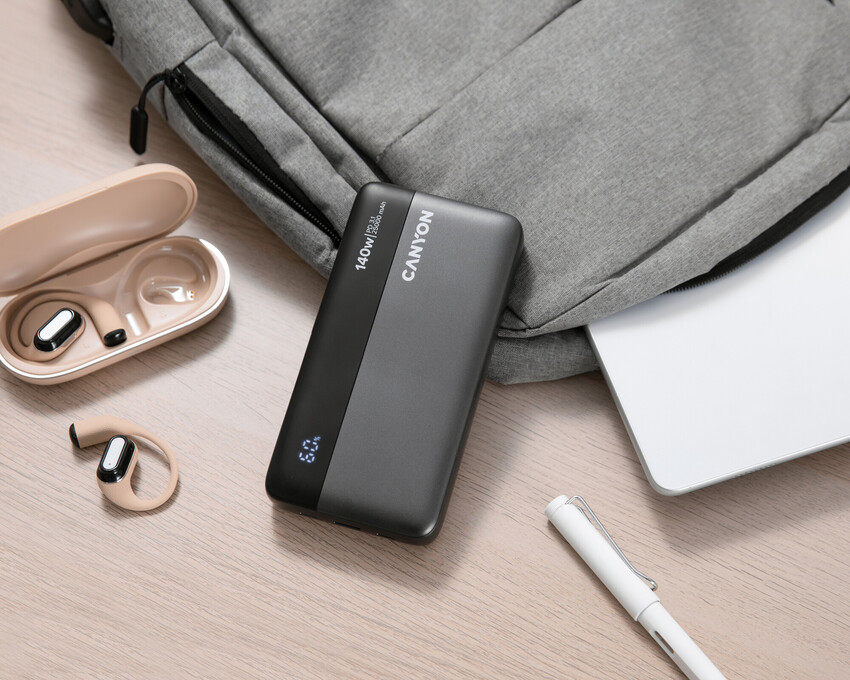
The heavy hauler, built to keep a laptop running between meetings or in a lounge. It pushes 140 W of ultra-rapid charging from a 25,000 mAh cell, sits at the top of the safe band at 92.5 Wh, and still boards with no airline approval. Three ports let a laptop, a phone and a tablet feed off one brick.
Canyon power bank PB-2008: 20,000 mAh / 74 Wh, 100 W output
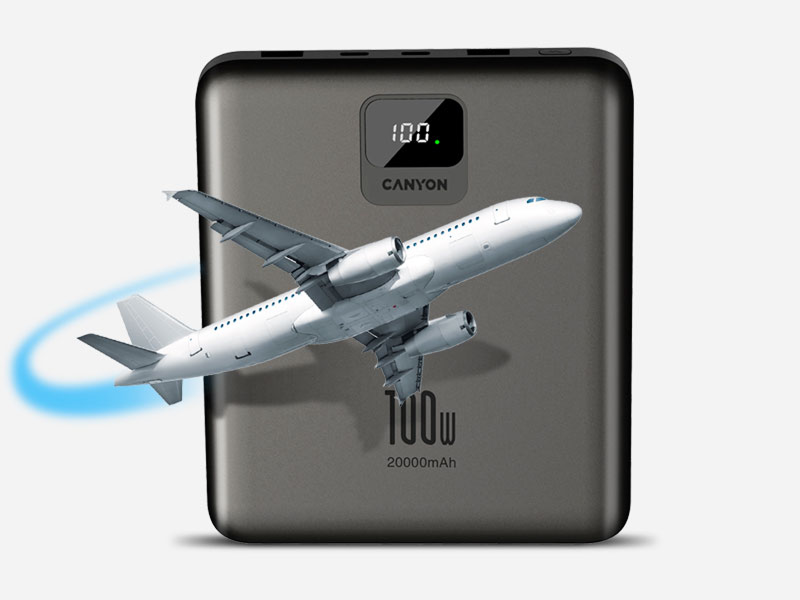
Made for travelers whose laptop needs juice mid-journey. The 100 W USB-C output keeps most modern laptops topped up, and the 20,000 mAh cell adds several phone charges on the side. Same airline-safe 74 Wh as the OnPower 600, with more output for bigger devices.
Every one of these answers the question is powerbank allowed in flight with a plain yes. They carry clear labels, sit under 100 Wh, and run the safety systems international rules require.
Can you use a power bank during the flight?
On most airlines, yes. Once you are past the checkpoint and in your seat, you can charge a phone or tablet from a power bank the same way you would at home. Some carriers ask you to keep batteries switched off during taxi, takeoff and landing, and to stow them where crew can reach them, so listen to the safety briefing and check the airline’s own page before you count on it. Two habits keep you out of trouble: keep the bank in the seat pocket or your under-seat bag rather than the overhead bin, where a fault would sit out of sight, and stop charging the moment a device or the bank runs warm. If crew ask you to put a battery away, do it. They work from the same fire-safety rules that put the bank in your hand luggage to begin with.
Does your phone or laptop count against the limit?
The 100 Wh ceiling applies to spare batteries and power banks, the ones not installed in a device. The battery inside your phone, tablet or laptop travels as part of that device and doesn’t count toward your power-bank allowance, though the laptop still rides in carry-on for the same fire reason. A typical laptop battery lands between 40 and 90 Wh, inside the passenger limit on its own. People slip up on loose spares: an extra laptop cell or a bag of camera batteries follows the same rules as a power bank, so tape over the terminals or keep each in its own case, and count them toward your two-spare allowance.
The takeaway
So, can you take a battery on a plane? Yes, provided it rides in your carry-on and stays under 100 Wh, which describes nearly every consumer model built for travel. And one more version of the question that comes up often: can you bring a battery pack on a plane the same way? Same rules apply, since “battery pack” is another name for the same device. Keep yours in your hand luggage, wear a clear label, hold a sensible capacity, and your travel bank becomes one of the most useful things in the bag: a steady charge waiting at every gate and seat for years.

 Angelina
 Tatyana Ryzhova
 Herzberg